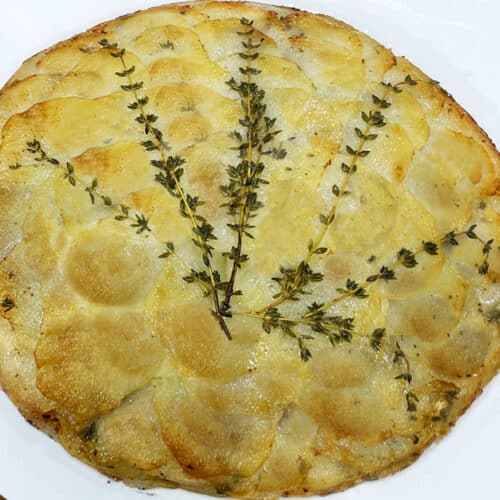
Chef Jean-Pierre’s Pommes Boulangère is a classic, dairy-free French potato bake featuring thinly sliced potatoes and caramelized onions roasted in a rich savory broth. By slowly baking the dish until the broth is absorbed, the potatoes become melt-in-your-mouth tender on the inside while developing a perfectly crisp, golden-brown crust on top.
Key Takeaways
100% Dairy-Free: This rich, savory bake achieves its flavor using absolutely no milk, cream, or cheese
Highly Adaptable: The recipe uses beef stock for deep flavor, but you can easily swap in vegetable stock for a vegetarian/vegan side dish.
The Right Potato Matters: Always use Yukon Gold potatoes. Starchier varieties like Russets will turn to mush, whereas Yukon Golds hold their shape while perfectly absorbing the broth.
A Classic French Potato & Onion Bake: the Most Delicious Potatoes in the World!
Hello friends! This Pommes Boulangère — a proper French Potato & Onion Bake — is pure comfort: silky potatoes and sweet caramelized onions melting together in stock. Elegant enough for company, yet so simple a child could do it. Make it ahead, and it’s a weeknight hero!
Let me tell you where this beautiful dish comes from, my friends. We’re going back to France in the 1700s and 1800s, when almost nobody had an oven at home. The village baker — the boulanger — would fire up his wood oven through the night to bake bread. On Sundays, the neighbors would carry their roasts and their potatoes down to the bakery to cook in that still-hot oven. That is how Pommes Boulangère — literally “Baker’s Potatoes” — was born.
Two hundred years later, it’s still one of the simplest, most delicious potato dishes you can possibly make.
What Is Pommes Boulangère?
Pommes Boulangère — also called Baker’s Potatoes or a French Potato & Onion Bake — is a traditional French side dish of thinly sliced potatoes layered with caramelized onions, fresh thyme, and butter, then slow-baked in stock until tender and golden.
Top 3 Common Mistakes (and How to Fix Them)
1. Slicing the potatoes too thick. Thick slices won’t cook evenly and they won’t bind into those beautiful layers. The fix: go whisper-thin. A mandoline is the perfect tool for the job — but please, use the hand guard. It is the most dangerous tool in the kitchen, so don’t talk to anyone, don’t watch TV, just watch the mandoline. No mandoline? A sharp knife and a little patience will do it — just keep your fingers where you can see them, and respect the knife.
2. Rushing the onions. Raw, pale onions have no sweetness, and burnt ones turn bitter. The fix: low and slow, 15 to 20 minutes or more, in a fry pan so the moisture escapes. Salt them early to pull out the water, keep shaking and twisting the pan, and cook them until they’re genuinely caramelized and sweet. Don’t be afraid to make extra — caramelized onions are delicious on everything.
3. Skipping the cartouche (or a lid). Bake it uncovered from the start and the potatoes dry out before they’ve absorbed any flavor. The fix: cover it for the first hour so the potatoes cook in the moisture and drink up the stock. No lid that fits your dish? Cut a parchment cartouche — fold, snip, drop it right on top. Then finish uncovered so the top can brown.
Pommes Boulangère — literally “Baker’s Potatoes” is one of the simplest, most delicious potato dishes you can possibly make. Beautiful enough for company.
Is it quick? No. It’s a work of art. But anybody can cook it, so simple a child can do it! All you need are the fundamentals.
So, what are we waiting for? Grab a glass of wine and let’s get cooking!
Pommes Boulangère is one of those magnificent old-fashioned dishes made from the simplest ingredients: potatoes, caramelized onions, fresh thyme, butter and flavorful stock. The potatoes cook slowly until meltingly tender while the onions add deep sweetness and the top develops a beautiful golden finish. The name means “potatoes in the baker’s style,” recalling the French village tradition of bringing prepared dishes to the baker after the bread was finished so they could cook in the oven’s remaining heat. Simple ingredients—but certainly not simple flavor!
6mediumYellow Onionsthinly sliced with the grain and cut into shorter pieces
2tbspclarified butter or olive oil - 30 mltaken from the 6 tablespoons total
1tspKosher salttaken from the 2 teaspoons total
Ground black pepper or white peppertaken from the ½ teaspoon total
For the Potatoes and Layers
4lbsYukon Gold potatoes — 1.8 kg
4tbspRemaining clarified butter or olive oil - 60 ml
2tbspFresh thyme leaves, divided — 6 g
1tspKosher Salttaken from the 2 teaspoons total
ground black pepper or white pepperas needed
1½ cupshomemade beef stock, chicken stock, or vegetable stock, as needed — 350 ml
Get Recipe Ingredients
Prevent your screen from going dark
Recipe Instructions
Prepare the Onions
Peel the onions and cut them in half from top to root.
Thinly slice the onions with the grain, from root to stem rather than across the grain. This helps the onions retain some structure as they cook.
Cut the long onion slices in half. If using especially large onions, cut them into thirds. Keeping the pieces shorter will make the finished Pommes Boulangère easier to portion and eat.
Caramelize the Onions
Heat 2 tablespoons clarified butter or olive oil in a wide sauté pan over medium-high heat.
Add the sliced onions and season with some of the salt and pepper.
Spread the onions across the pan in an even layer. A wide pan is important because it allows moisture to escape rather than collecting and steaming the onions.
Cook for approximately 20 to 30 minutes, turning or tossing the onions about every 2 minutes.
Continue cooking until the onions are: * Soft * Sweet * Deeply golden * Reduced considerably in volume
Watch them carefully toward the end of cooking because they can brown quickly once much of their moisture has evaporated.
Transfer the onions to a wide tray or pan and spread them out. Allow the heat and steam to escape until the onions are cool enough to handle comfortably.
Prepare the Potatoes
Peel the potatoes and keep them completely submerged in cold water until you are ready to slice them.
Remove one potato at a time and dry it thoroughly.
Using a mandoline or very sharp knife, slice the potatoes approximately:¹⁄₁₆ inch / 2 mm thick
Do not rinse the potato slices. The natural starch remaining on the potatoes helps the layers hold together during cooking.
Mandoline Safety: Use the hand guard whenever possible, keep your palm and fingers safely away from the blade, and give the mandoline your full attention. Be very careful. The blades are very sharp!
Prepare the Baking Dish
Preheat the oven to 275°F / 135°C.
Lightly butter a 10-inch oven-safe pie pan or round baking dish.
Have a piece of parchment paper ready to make a cartouche that will sit directly on top of the potatoes during the first stage of baking.
Build the First Potato Layer
Brush the bottom and sides of the baking dish with melted clarified butter.
Arrange overlapping potato slices across the entire bottom of the dish.
Make sure there are no empty spaces. This first layer forms the base of the Pommes Boulangère.
Season lightly with: * Salt * Pepper * A small amount of fresh thyme
Drizzle in a small amount of stock.
Spread a thin layer of caramelized onions over the potatoes.
Keep most of the onions slightly away from the outside edge of the dish for a cleaner finished appearance.
Continue Building the Layers
Continue layering the ingredients in the following order: 1. Potatoes 2. Light seasoning of salt and pepper 3. Fresh thyme 4. A little clarified butter 5. A little stock 6. Caramelized onionsRepeat until the ingredients are nearly used.
Important Structural Layer
Around the middle of the dish, place two consecutive layers of potatoes before continuing with the onions.This provides additional structure and helps the finished dish hold together when portioned.
Finish the Top
Finish with an attractive overlapping layer of potato slices.
Press the potatoes down firmly but carefully to compact all of the layers.
Gradually add the remaining stock.
Give the stock time to filter down through the potato layers.The potatoes should be thoroughly moistened but not completely submerged.
Brush the top generously with clarified butter.
Sprinkle with a small amount of fresh thyme.
Cover the Potatoes
Place a parchment-paper cartouche directly against the surface of the potatoes.
Cover the baking dish with a tight-fitting lid.
If you do not have a suitable lid, cover the baking dish tightly with aluminum foil.
Keeping the dish covered during this first stage traps the moisture and allows the potatoes to become tender in the stock.
First Bake - Covered
Bake at: 275°F / 135°C for 1 hour
After 1 hour, remove the baking dish from the oven.Remove: * The lid or foil * The parchment-paper cartoucheThe potatoes may still feel somewhat firm at this stage.
Second Bake - Uncovered
Return the potatoes to the 275°F / 135°C oven uncovered.Bake for another: 30 to 45 minutes
During this stage: * The top develops color. * Some of the remaining stock evaporates. * The potatoes finish cooking. * The remaining liquid becomes concentrated and is absorbed by the potatoes.
How to Know They Are Done
Insert a toothpick through the center of the potatoes.It should pass through without resistance.A small amount of stock may still be visible around the potatoes. That is normal.
Rest and Absorb the Stock
Remove the finished Pommes Boulangère from the oven and allow it to rest.
Do not be concerned if some liquid remains visible immediately after baking.
As the potatoes cool, they continue absorbing the flavorful stock and onion juices.
The dish can be served the same day after resting, but it will be softer and more difficult to portion cleanly.
Recommended Make-Ahead Method
For the best flavor and easiest presentation, prepare the Pommes Boulangère one day ahead.
Cool and Refrigerate
Allow the potatoes to cool completely.
Cover the baking dish.
Refrigerate overnight.
During this time: * The potatoes absorb the remaining stock. * The layers become more cohesive. * The flavor develops. * The dish becomes considerably easier to portion.
Reheat the following day:
Preheat the oven to 250°F / 120°C.
Cover the potatoes.
Reheat for approximately 45 minutes, or until the center reaches: 150°F / 65°C
Watch the surface while reheating. If it begins becoming too brown, place another parchment-paper cartouche directly over the top.
Finish and Serve
Brush the warm potatoes lightly with clarified butter.
Garnish with fresh thyme leaves.
Cut into wedges or generous portions.
Serve warm.
Do not expect Pommes Boulangère to cut like a firm potato terrine or a slice of pie. The traditional texture should be soft, moist, tender, and almost melting.
Pro-Tips
Chef’s Notes
A mandoline produces the most consistent slices, but it is also one of the most dangerous tools in the kitchen. Use the hand guard, keep your palm flat and concentrate completely while slicing.
Yukon Gold potatoes provide the best balance of buttery flavor, absorption and structure for American cooks. Agria or Bintje potatoes are excellent European alternatives.
Homemade beef stock produces the deepest traditional flavor. Chicken or vegetable stock may be substituted, but watch the seasoning carefully when using commercially prepared stock because its salt becomes concentrated during cooking.
Do not expect the potatoes to cut exactly like a firm potato terrine. Traditional Pommes Boulangère should be soft, moist and meltingly tender.
The dish can be served shortly after baking, but allowing it to cool overnight gives the potatoes time to absorb the stock and makes it considerably easier to portion.
Serving Suggestions
Serve Pommes Boulangère with roasted lamb, beef, chicken or pork. When prepared with vegetable stock, it also makes an excellent vegetarian main course accompanied by a green salad or roasted vegetables.
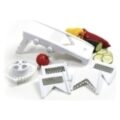
Equipment - You can find the items below at our online store!
This dish was born under the Sunday roast, my friends — so that is exactly where it shines.
Roast Leg of Lamb
A classic marriage. Those sweet, savory onions and potatoes are made for a little lamb.
A Simple Roast Chicken
Sunday-supper perfection, and it can share the same low oven while the potatoes finish.
A Roast Beef Tenderloin
Rich and hearty, and if you baked your potatoes in beef stock, they truly sing together. Add a crisp green salad with a sharp vinaigrette to cut through all that richness.
Make-Ahead and Storage
Make the onions ahead. Caramelize them whenever you like, spread them out in a lasagna pan (not a bowl!) so the steam can escape, and let them cool. Do the potatoes when you’re ready.
Freezing the onions. Make sure every last bit of water is gone first — put your hand over them, and if you still feel steam, keep going. Freeze them wet and the water crystallizes, breaks them down, and you get mushy onions. Done right, they keep for ages (I like to joke, 17 years!).
Make the whole dish ahead. This is the way, my friends. Bake it, cool it, and refrigerate it overnight. Straight from the fridge it will look dull and congealed — that is completely normal.
Reheat it low and slow. Warm it in a low oven, around 250°F, until the center reaches about 150°F (roughly 30 minutes, depending on the size of your dish). Cover it with a lid, or wrap it in foil with a little butter smeared on the inside. If the top starts to brown too fast, lay a cartouche right on top. To finish, brush on a little clarified butter — a bit of “makeup” — and sprinkle over some fresh thyme to make it pretty.
Why go to the trouble? Cut it too soon and it falls apart, because the potatoes haven’t absorbed the stock yet. Give it a night in the fridge and it slices beautifully. And remember — it’s a rustic dish, so it won’t slice like a piece of pie, and that is part of its charm.
Frequently Asked Questions
When making Pommes Boulangère can I use chicken or vegetable stock instead of beef stock?
Absolutely, my friends. Beef stock is the traditional choice, but chicken or vegetable both work beautifully. Vegetable stock even makes this a perfect vegetarian dish.
Do I need a mandoline to make Pommes Boulangère?
No — a sharp knife and a little patience will get your slices thin enough. A mandoline is faster and gives you nice even slices, but it is the most dangerous tool in the kitchen, so always use the hand guard.
What’s the difference between Pommes Boulangère and a potato gratin (Dauphinoise)?
Pommes Boulangère is baked in stock with onions, so it’s lighter and savory. Add cream and cheese and you’ve made a gratin — delicious, but it’s no longer a Baker’s Potatoes.
When making Pommes Boulangère should I rinse my potato slices first?
Never rinse them, friends. You can keep the whole potatoes in water so they don’t discolor, but the starch on the cut slices is exactly what binds all those layers together as they bake.
Chef Jean-Pierre, born in Aix-en-Provence, France, honed his culinary skills at a young age, mastering the art of charcuterie by the age of twelve. Determined to become a chef, he began his formal apprenticeship at L'Oustau de Baumaniere in Provence, one of the world’s best restaurants with a 3-star Michelin rating.
Jean-Pierre continued his apprenticeship on the French Riviera where he worked at famous restaurants, such as L’Oasis at La Napoule, Le Vendome in Aix-en-Provence, and the the Carlton in Cannes. In 1976, he opened The Left Bank Restaurant, consistently recognized as one of the best in America for 22 years by magazines like "Bon Appetit," "Conde Nast," "Gourmet Magazine" and "Travel & Leisure."
Jean-Pierre was also a popular TV personality, having hosted National Public Television series like "Incredible Cuisine” and "Sunshine Cuisine." He was also nominated for "Best Culinary Video" by the James Beard Foundation and operated the nationally renowned “Chef Jean-Pierre's Cooking School” and was a sought-after guest on shows like "The Today Show" and "Larry King Live."
With 2.4 Million Subscribers to his Chef Jean-Pierre YouTube Channel, he is a widely respected figure in the culinary world, known for his skill and dedication to his craft, but even more so known for making gourmet cooking fun and easy to learn.
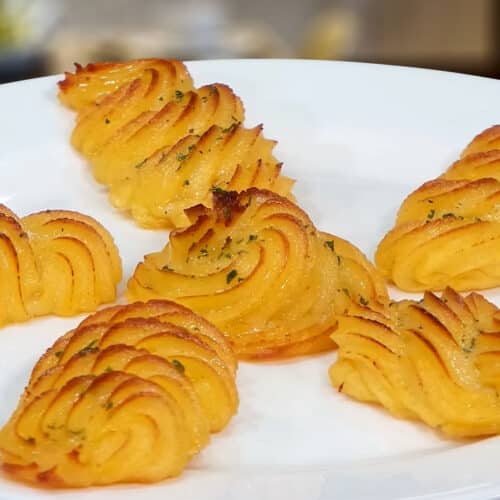
Classic Pommes Duchesse / Duchess Potatoes Classic Duchess Potatoes Made Easy: Elegant, Creamy and Perfect for Special Dinners Hello friends... today we're taking mashed potatoes and making them fancy!…
I’ve not made this yet but compliments on a well written, fool-proof, recipe. I suspect Jack has had a hand in putting this to paper. So glad to see our favorite chef posting recipes again.
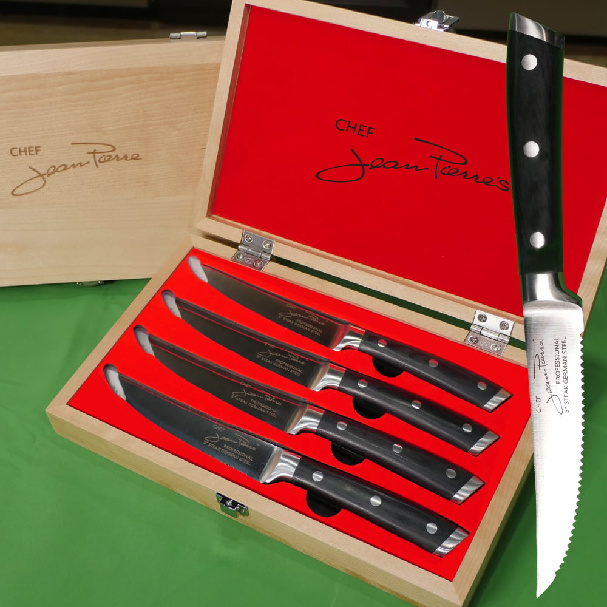
5-inch high-carbon German Stainless Steel blade will effortlessly slice through your steak, bread, vegetables, and fruits. The handle is ergonomically designed Pakka Wood. Makes a perfect gift presented in a beautifully crafted wooden box.

















Love Pommes Boulangere. I often cook it with lamb roasting above, so the lamb juices add to the flavour.
One of the most detailed recipes I’ve seen. Glad to have you back Chef.
There is no recipe!
Must have been a glitch in the matrix! The recipe is back!
I’ve not made this yet but compliments on a well written, fool-proof, recipe. I suspect Jack has had a hand in putting this to paper. So glad to see our favorite chef posting recipes again.